Big Two rules
The TV, joining from your phone and the rest of how a table works are in How to play.
The aim
Four players get thirteen cards each. Be the first to play them all. Everyone else is left holding cards, and every card left is a penalty point. After 8 deals the lowest total wins.
- Someone leads. They play one card, a pair, three of a kind or a five-card hand.
- Beat it or pass. In turn, each player plays the same number of cards, higher, or passes. You may pass even when you could play.
- Everyone passes. Whoever played last leads again, with anything they like. When the cards already played show nobody can beat a play (the 2 of spades, say), everyone passes on it at once.
- First out wins the deal. The deal stops the moment someone plays their last card.
Card order
The 2 is the highest card, then the ace, king and so on down to the 3, the lowest.
Suits break ties between cards of the same rank: diamonds are lowest, then clubs, hearts and spades. So the 2 of spades is the top card of the game and the 3 of diamonds the bottom.
What you can play
A play is one of these. To beat a play you need the same number of cards.
Five-card hands, weakest first
Any stronger kind beats any weaker kind: the lowest flush beats the highest straight.
Scoring
When someone goes out, the others count the cards they still hold.
| Cards left | Points | For example |
|---|---|---|
| 1 to 9 | 1 a card | 4 cards: 4 points |
| 10 to 12 | 2 a card | 10 cards: 20 points |
| All 13 | 3 a card | 39 points |
The player who went out scores nothing. A match is 8 deals unless the table picks another length, and the lowest total wins.
Hong Kong rules
A new table plays these eight rules with one change, its house rules: you may go out on any card, a single 2 included (rule 4). Anyone at the table can change any rule before the first deal, and the table always shows which ones it is playing.
1. Straights, highest first
A-2-3-4-5 is the highest straight and 2-3-4-5-6 the next. After those two, the higher the top card, the better. When two straights are the same, the suit of the top card decides. Straight flushes follow the same order.
2. Flushes
The highest card decides, then the next highest, and so on down. Only when all five ranks match does the suit of the highest card matter.
3. Dragon
A dragon is one card of every rank, dealt to you. It wins the deal at once, before a card is played, and the other three score 39 each. If more than one player is dealt a dragon, the one holding the 2 of spades wins.
4. Last card
You can't go out on a single 2. A pair of 2s, or a 2 inside a five-card hand, is fine. If it is your lead and a single 2 is all you hold, you may play it. House rules leave this out: at a new table you may go out on any card.
5. Next deal
The first deal is led by whoever holds the 3 of diamonds, and their first play must include it. After that, the winner of each deal leads the next, with anything. If the winner has left the table, whoever holds the 3 of diamonds leads, and must play it.
6. After a pass
A pass only skips that turn. If the play comes round to you again, you can play.
7. One card left
When the player after you has one card left and you play a single, it must be the highest card you hold. You can still pass, or play a pair or more.
8. Out on all 2s
Going out on a play made only of 2s earns nothing extra.
Alt rules
Each rule has another way of being played. House rules use the one marked Default; a table that uses another marks it Alt rule in “Rules at this table”, on the TV and on every phone. Anyone at the table changes the rules in the table's settings before the first deal, or once a match is over for the next one; they are locked while a match is in play.
| Rule | Hong Kong rules | Other ways |
|---|---|---|
| 1. Straights |
Default
A-2-3-4-5 high
A-2-3-4-5 is the highest straight, then 2-3-4-5-6. J-Q-K-A-2 is not a straight. |
Alt rule
2 high
J-Q-K-A-2 is the highest straight and 3-4-5-6-7 the lowest. A-2-3-4-5 and 2-3-4-5-6 are not straights.
Alt rule
2 low
10-J-Q-K-A is the highest straight and A-2-3-4-5 the lowest. J-Q-K-A-2 is not a straight. |
| 2. Flushes |
Default
Highest card
The highest card decides, then the next highest, and so on. If all five ranks match, the highest card's suit decides. |
Alt rule
Suit first
The higher suit wins, whatever the cards. In the same suit, the highest card decides. |
| 3. Dragon |
Default
Wins the deal
One card of every rank, dealt, wins the deal at once. The others score 39 each. |
Alt rule
Off
No dragon: a hand with one card of every rank is played as usual. |
| 4. Last card |
Hong Kong
Not a single 2
You can't go out on a single 2, unless it's your lead and it's all you hold. |
Default
Any card
You may go out on any card, a single 2 included. |
| 5. Next deal |
Default
Winner leads
The winner of a deal leads the next, with anything. If they've left, the 3 of diamonds leads. |
Alt rule
3♦ leads
Whoever holds the 3 of diamonds leads every deal, and must play it. |
| 6. After a pass |
Default
Play again
A pass only skips that turn: you can play again when it comes back round. |
Alt rule
Locked out
Once you pass, you can't play again until the next lead. With this rule, “the next player” in rule 7 means the next one who can still play.
|
| 7. One card left |
Default
Highest single
When the next player has one card left, a single you play must be your highest. You can still pass. |
Alt rule
No rule
You may play any single, however few cards the next player holds. |
| 8. Out on all 2s |
Default
No bonus
Going out on a play of only 2s earns nothing extra. |
Alt rule
Doubles
Going out on a play of only 2s doubles the others' points for the deal. |
On your phone
Tap cards to choose them; tap again to put one back. The line under your hand names what you have chosen and says whether it can be played. Play lights up when it can.
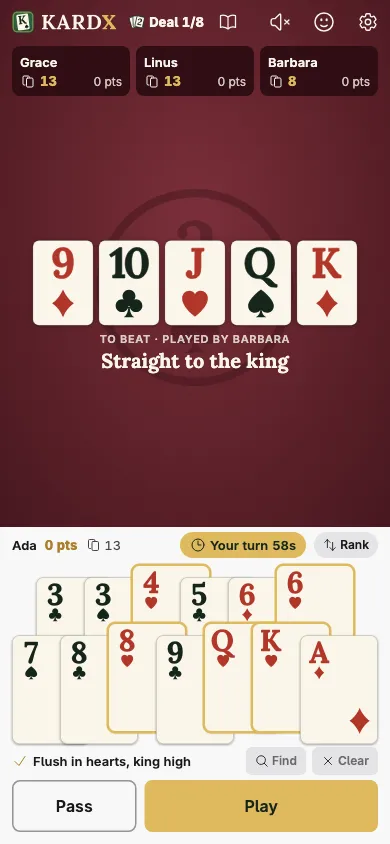
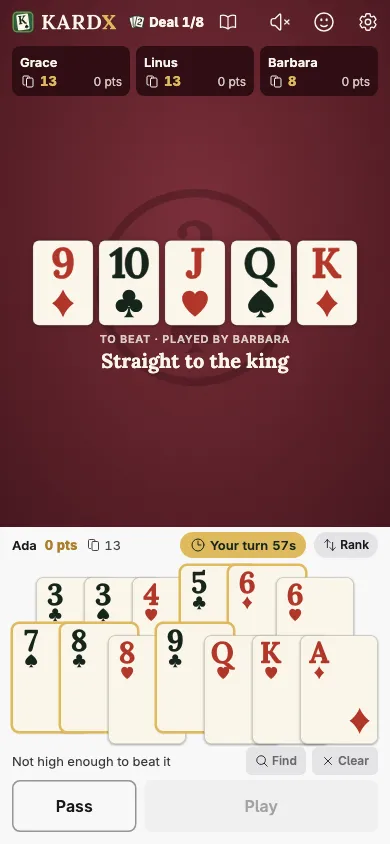
- Sorting. The button above your hand steps through rank, suit and plays (your hand split into the fewest plays it makes). To put a card where you like, hold it a moment and drag it.
- Find and Clear. Find picks a play from your hand, the next one each time you tap it: the plays that beat the table or, when you lead, your five-card hands, threes and pairs. Clear puts back every card you picked.
- The clock. If your time runs out you pass. If you are leading, one card is played for you: your lowest, unless the rules call for another (the 3 of diamonds when it has to be led, your highest when the next player has one card left).
- Away. If your phone drops off the table and two of your turns run out, a bot plays your cards for you, under your name, until you're back.
- Leaving. If you leave during a deal, a bot takes your seat and your cards and plays the deal out. The seat keeps its points for whoever sits there next.
- Bots. Big Two needs four players. Bots fill the empty seats when a deal starts; they play by the table's rules. Someone joining a table with a bot at it takes a bot's seat at once, with its cards and points, even in the middle of a deal.
-
Bot levels.
Bots that fill seats at the start play at the Good level; in the
settings a player can add bots at any level:
- Good plays a plain game: its lowest cards first, and it keeps its 2s back early on.
- Great plans its hand into the fewest plays, remembers what's been played, and plays hard when someone is nearly out.
- Pro plays like Great, but first tries its best few moves against many guesses at the cards it can't see, and makes the one that does best.