Tutorial · Texas Hold'em
How to play Texas Hold'em: a beginner's guide
Learn Texas Hold'em in ten minutes: the blinds, the four betting rounds, what you can do on your turn and who wins at the showdown, with a hand played out.
- 10 minutes to read
KARDX is a free card table for your TV: everyone plays on their own phone.
Texas Hold'em is the poker most people mean when they say poker. Everyone gets two cards of their own, five cards are dealt face up for the whole table to share, and you make the best five-card hand you can from those seven. Between the cards come rounds of betting, and that's where the game is.
You can learn it in one sitting. This page goes through a hand in the order it happens, and the Texas Hold'em rules are the short version. The tips near the end are standard beginner advice, not something measured against KARDX's bots.
The idea in one minute
- You get two cards face down. Only you see them.
- Five cards are dealt face up in the middle, in three stages. Everyone can use them.
- Your hand is the best five cards out of your two and the five in the middle.
- There are four rounds of betting. In each one you can stay in by matching the bet, or fold and wait for the next hand.
- You win the pot in one of two ways: everyone else folds, or you show the best hand at the end.
The first of those two ways is why poker isn't only about cards. A bet can win a pot with nothing, if everyone believes it.
1. The dealer button and the blinds
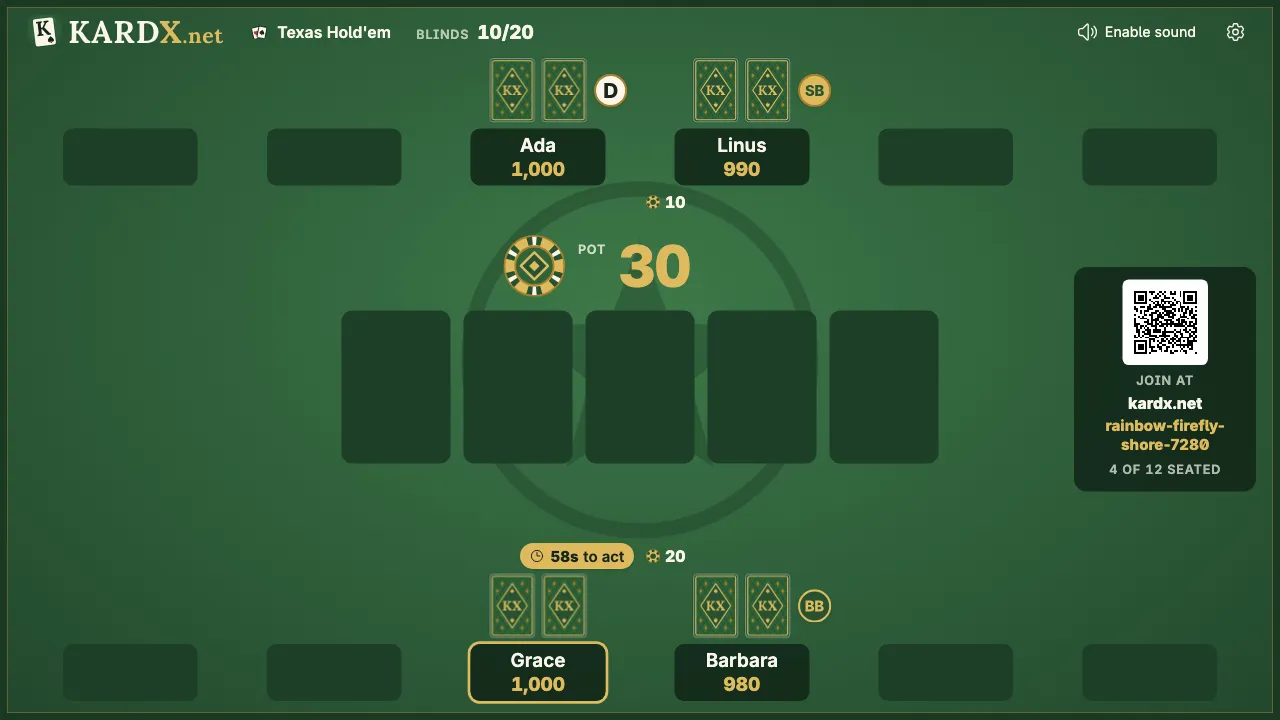
One seat has the dealer button (D) for the hand. KARDX does the actual dealing; the button just marks where each hand starts. It moves on to the next seat after every hand, so it goes around the whole table.
Before any cards come out, the next two players after the button put in forced bets called blinds, the small blind (SB) and the big blind (BB), so there's always something in the pot to play for. Poker blinds explained has the rest.
2. Two cards each, and the first bets
Everyone is dealt two cards face down. These are your hole cards.
The first round of betting starts with the next player after the big blind, and play passes around the table from there. When play reaches you, you have three choices:
- Fold. Give up your cards. You lose nothing more, and you're out until the next hand.
- Call. Match the current bet. Before the flop, that's the big blind unless someone has raised.
- Raise. Bet more, so everyone after you has to match the new amount to stay in.
The round ends when everyone still in has acted and has put in the same amount. The big blind acts last, and if nobody raised they can check (stay in for free) or raise.
3. The flop
Three cards are dealt face up in the middle, where everyone shares them (the board). This is the flop, and it's when most hands take shape: you now have five cards to look at.
Another round of betting follows, starting with the first player still in after the button. From here on, if nobody has bet yet you can check, which passes play on without putting chips in. Once someone bets, the choices are fold, call or raise again.
4. The turn and the river: a fourth card, then a fifth
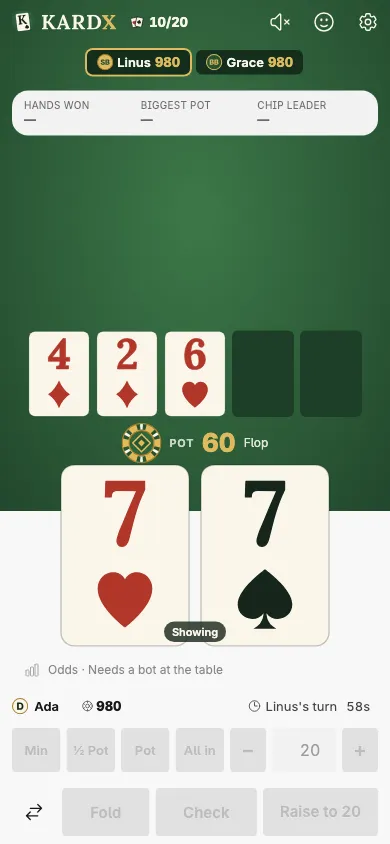
A fourth card is dealt face up, and another round of betting follows. Players call this card the turn, which has nothing to do with whose turn it is to act. Then comes the fifth and last card, the river, and one more round of betting. After this there are no more cards to come, so what you have is what you have.
5. The showdown
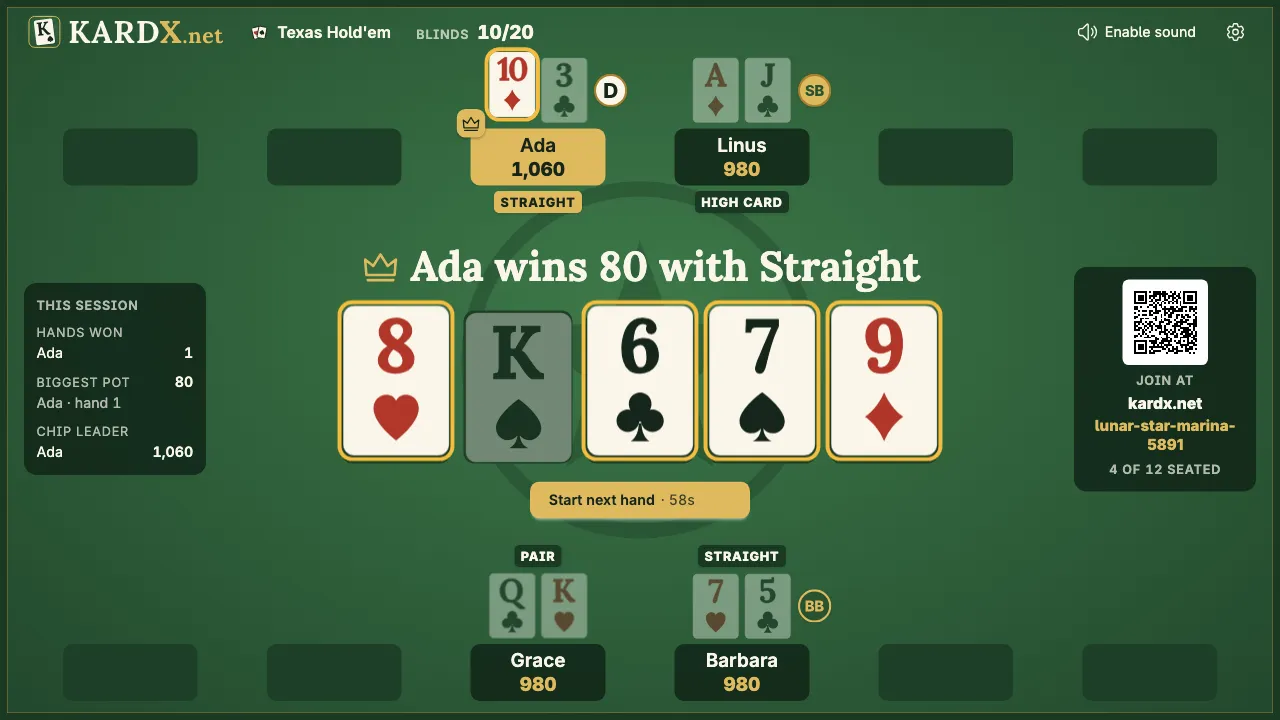
If two or more players are still in after the last bet, they turn their cards over. The best five-card hand wins the pot. If two hands are exactly as good, the pot is split.
You can use both of your cards, one of them, or neither: if the five cards in the middle are the best hand anyone can make, everyone still in shares the pot.
What beats what
From best to worst:
| Hand | What it is |
|---|---|
| Royal flush | A K Q J 10, all one suit |
| Straight flush | Five in a row, all one suit |
| Four of a kind | Four cards of one rank |
| Full house | Three of a kind plus a pair |
| Flush | Five of one suit |
| Straight | Five in a row, any suits |
| Three of a kind | Three cards of one rank |
| Two pair | Two different pairs |
| Pair | Two cards of one rank |
| High card | None of the above |
The two that trip people up: a flush beats a straight, and a full house beats both. The poker hand rankings page covers ties, kickers and the other things that come up at a real table.
A hand, played out
Four players: Ada, Linus, Barbara and Grace. The blinds are 10 and 20. Ada has the button, so Linus posts 10 and Barbara posts 20.
Before the flop. Grace is first to act and holds this:
A strong start. She raises to 60. Ada folds. Linus folds and loses his 10. Barbara has a pair of eights and calls, putting in 40 more.
The pot is 130: 60 from each of them and Linus's 10.
The flop.
Barbara now has three eights. Grace has a pair of jacks, and four spades: one more spade would give her a flush. Barbara checks, hoping Grace will bet. Grace bets 80. Barbara calls. The pot is 290.
The turn.
No help for anyone. Barbara checks again, Grace bets 150, and this time Barbara raises to 300, the smallest raise she can make. The pot is 740, and it costs Grace 150 more to stay in.
Grace thinks it through. She's probably behind, so she needs a spade. Nine spades are left, but the 2♠ would pair the board and give Barbara a full house, so only 8 of them win for her. That's 8 good cards out of the 46 she can't see: a 17% chance. Her call would make the pot 890, and 150 is 16.9% of that. Her chance is barely bigger than the price, so it's a close call, but a correct one. She calls. The pot is 890.
Poker odds for beginners shows how to do that math at the table.
The river.
The spade arrives. Barbara checks: a third spade on the board means anyone with two spades has a flush, so she's careful. Grace bets 450, about half the pot, and Barbara calls. At the showdown Grace's flush beats Barbara's three eights, and Grace takes the pot of 1,790.
Barbara played it well and lost anyway. That happens. Over many hands the good decisions win; in one hand, the river decides.
No-limit, all-in and side pots
The Hold'em on KARDX is no-limit, the most common kind: when you act you can bet any amount up to everything in front of you.
- The smallest bet is the big blind. The smallest raise is the size of the last bet or raise: if someone bets 100, a raise has to make it at least 200.
- All-in means betting all your chips. If you can't cover a bet you can still call with what you have. You can only win from each player as much as you put in yourself.
- Side pots are what happens to the rest. When one player is all-in and others keep betting, the extra goes into a separate pot that only they can win. On KARDX the table works these out for you.
Poker betting rules goes through all three, with a side pot worked out.
If you run out of chips, you're out until the table starts a new game.
Five things to do in your first games
- Fold most hands. Play only good starting hands and you'll fold about six hands in seven before the flop. Two low cards that don't match are not worth a call.
- Play big cards and pairs. Two of aces, kings, queens and jacks, better still in one suit, and pairs. Small pairs only when it's cheap to see the flop. Texas Hold'em starting hands sorts them into groups.
- Notice where you sit. Acting last is an advantage: you see what everyone else does first. Play a few more hands when you have the button, fewer when you're first to act. Position in poker has more.
- Bet when you have it. Checking a strong hand to be sneaky gives everyone a free card to beat you with.
- Don't pay to see it. If you're calling only because you're curious what they have, fold.
Try it
Open a Texas Hold'em table, join from your phone and press Play with bots. At every showdown, before you read what the TV says, pick the best five cards for each hand still in and say who wins. Then check your answer against the TV. When you're ready for people, here's how to host a poker night.
Texas Hold'em on KARDX
Open a table on the TV and everyone joins from their phone. Free, no accounts, and the chips are play money.
Keep reading
- Rules Texas Hold'em rules Texas Hold'em rules at a glance: how a hand goes from the blinds to the showdown, and the ten poker hands in order, best first, with pictures.
- Tutorial Host a poker night Run a Texas Hold'em night with no chips to count and no cards to shuffle. The TV is the table and each player's phone holds their cards. Free, no accounts.
- Guide Poker hand rankings The ten poker hands from royal flush to high card, with pictures, how often each one comes up in Texas Hold'em, and how ties and kickers are settled.