Guide · Texas Hold'em
Poker betting rules: check, call, raise, all-in
What you can do on your turn in Texas Hold'em: check, bet, call, raise or fold. Plus the smallest raise allowed, going all-in, and how side pots are split.
- 10 min read
KARDX is a free card table for your TV: everyone plays on their own phone.
The cards in poker are dealt for you. The betting is the part you play. There are only five things you can ever do on a turn, and a handful of rules say how small or how large a bet can be and what happens when someone runs out of chips.
This page covers those rules for no-limit Texas Hold'em, the game on KARDX. If you haven't seen how a hand goes from the blinds to the showdown, start with Texas Hold'em for beginners and come back.
Your choices on a turn
What you can do depends on one thing: has anyone bet yet in this round?
| Move | When | What it does |
|---|---|---|
| Check | Nobody has bet | Passes play to the next player. You stay in and put nothing in. |
| Bet | Nobody has bet | Puts chips in. Everyone else has to match them to stay in. |
| Call | Someone has bet | Matches the bet. |
| Raise | Someone has bet | Makes the bet bigger. Everyone still in, the first bettor included, has to match the new amount. |
| Fold | Any time | Gives up your cards and whatever you've put in. You're out until the next hand. |
You can always fold, but don't fold when checking is free: you'd be giving up for nothing.
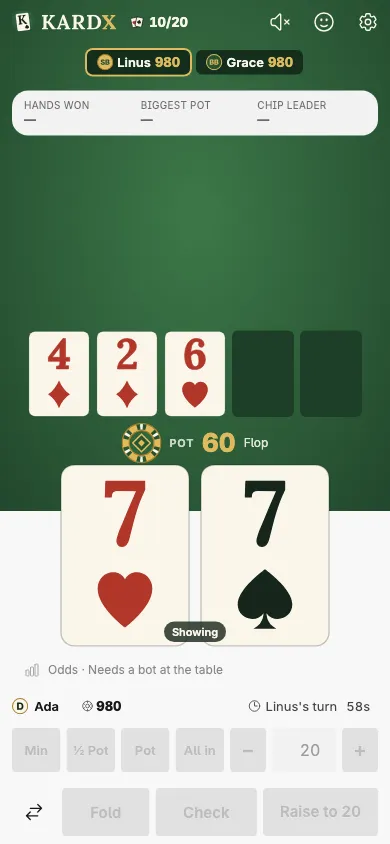
On your phone at a KARDX table, those five are three buttons. Fold is always there. The middle one reads Check when there's nothing to match and Call with the amount when there is. The third reads Raise to with an amount, and it's the button for a first bet as well as for a raise.
How a round of betting goes
A hand has four rounds of betting: before the flop, on the flop, on the turn and on the river. Each one works the same way.
- Play passes from seat to seat in a fixed order. Position in poker explains who goes first.
- The round ends when everyone still in has acted and has put in the same amount, or is all-in.
- A bet or a raise starts that count again: everyone else gets another turn to call, raise or fold.
- If everyone folds but one player, that player wins the pot there and then, and doesn't have to show their cards.
Before the flop there's one twist. The blinds count as bets, so nobody can check at first: staying in costs at least the big blind. If nobody raises, the big blind gets the last word and can check or raise.
Each round starts fresh. What you put in on the flop is already in the pot, and it doesn't count toward the bet on the turn.
How much you can bet
No-limit means the most you can bet is everything in front of you. The least is set by two rules.
The smallest bet is the big blind. With blinds of 10/20, the first bet in a round is at least 20.
The smallest raise is the size of the last bet or raise. If someone bets 100, a raise has to add at least 100 more, making it 200. If the raise is bigger, say to 400, that's a raise of 300, and the next raise has to add at least 300, making it 700.
| What's happened in this round | The smallest raise makes it |
|---|---|
| Blinds of 10/20, and nobody has raised | 40 |
| Before the flop, someone raised to 60 | 100 |
| A bet of 100 | 200 |
| A bet of 100, raised to 300 | 500 |
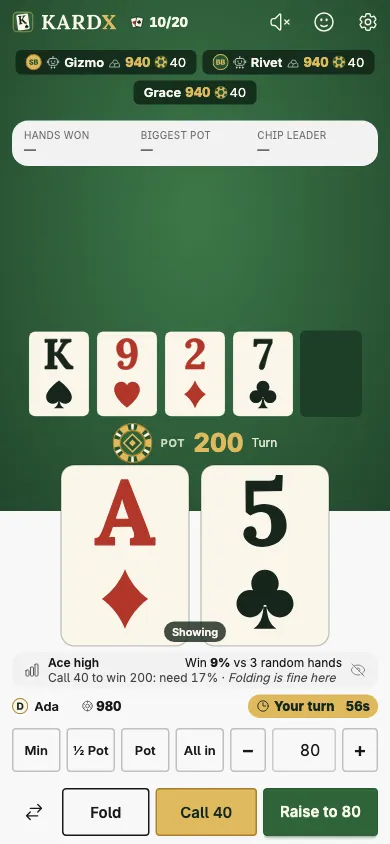
It's "raise to", not "raise by". The amount on the button is the total you'll have in for this round, not what you're adding. If you've already put in 20 and press Raise to 100, 80 more leaves your stack.
The one exception to both minimums is going all-in, covered below: you can always bet everything you have, even when it's less than the smallest bet or raise.
Setting the amount on your phone
Above the buttons there's a row for the size:
- Min is the smallest bet or raise allowed.
- ½ Pot and Pot size the bet from the pot. With nothing to call, Pot bets what's in the pot. Facing a bet, it adds your call to the pot first, then raises by that total. With 120 in the pot and 40 to call, Pot makes it 200: the 40, and a raise of 160.
- All in is everything you have. The raise button then reads All in with the amount.
- − and + move the amount by one big blind, and you can type a number in the box between them.
The quick sizes and the − and + buttons stay inside what's legal, and the table refuses a typed amount that isn't. You can't bet less than the minimum by accident, or more than you have.
Rules the buttons take care of
At a table with a deck and a pile of chips, these are the betting rules people break without meaning to:
- Acting out of turn. Folding or betting before it's your turn tells the players who haven't acted something they shouldn't know yet.
- String bets. A bet has to be made in one motion, or announced first. Putting some chips out, watching for a reaction, then adding more isn't allowed.
- Raising too little. A raise under the minimum has to be corrected, and someone has to notice.
- Losing count. Who's in for how much, and what's in the pot.
On KARDX none of them can happen. Your buttons only work on your turn. A bet is one tap for one amount. The table knows the minimum, counts the pot and shows what each player has put in. Each player's decision has a clock as well: if it runs out, the table checks for you when checking is free and folds your hand when it isn't.
Going all-in
Going all-in means betting every chip you have. A few things follow from it.
You can always call with what you have. If the bet is 300 and you have 180, you can still call. You put in your 180, and the button on your phone reads All in 180 instead of Call. Nobody can be pushed out of a hand just because someone bet more than they own.
You can only win what you matched. From each player you can win at most as much as you put in yourself. The rest of their bets go into a side pot that you're not part of. That's the next section.
You're done deciding. Once you're all-in there's nothing more for you to do. Your cards stay in until the showdown, and the TV marks your seat All in. If nobody left can bet, because everyone is all-in or everyone but one is, the rest of the cards are dealt straight out.
A bet nobody can match comes back. If you bet 500 and your only opponent has 300, they can call with their 300. The other 200 was never matched, and it's returned to you.
A short all-in doesn't reopen the betting. This is the rule that surprises people. If someone goes all-in for less than a full raise, the players who have already acted in that round can call the extra or fold, but they can't raise again.
Here's how that looks. On the flop, Linus checks. Barbara bets 100 and Grace calls. Ada has only 150 left and goes all-in. That's 50 more than the bet, and a full raise would have been 100 more.
- Linus checked before anyone bet, so he hasn't answered a bet yet. He has every choice: fold, call 150, or raise to 250 or more.
- Barbara and Grace have already acted on the 100. Each can put in 50 more or fold. Neither can raise, and on their phones the raise button stays off.
If Ada's all-in had been a full raise, to 200 or more, everyone would have had every choice again. The same goes if Linus raises: that's a full raise, and it reopens the betting for Barbara and Grace.
Side pots
When one player is all-in and others keep betting, the chips are divided into pots.
- The main pot holds what every player still in could match: the all-in player's chips, and the same amount from each of the others.
- A side pot holds the betting above that. Only the players who put chips into it can win it.
At the showdown, each pot goes to the best hand among the players who are in it. So the all-in player can win the main pot and nothing more, and a player with a worse hand than theirs can still win the side pot.
A side pot, worked out
The blinds are 10/20. Ada has the dealer button (D), Linus is the small blind and Barbara is the big blind. Linus is short: he has 200. Barbara and Grace have 1,000 each.
Before the flop. Grace raises to 60. Ada folds. Linus goes all-in for his 200. Barbara calls the 200 and so does Grace. That's 600 in the middle, and all three can win it. It's the main pot.
The flop. Linus has no chips left, so the betting is between the other two. Barbara bets 300 and Grace calls. Those 600 make a side pot that only Barbara and Grace can win.
The turn and the river. Barbara and Grace both check.
The showdown. Who gets what depends on whose hand is best:
| Best hand | Main pot, 600 | Side pot, 600 |
|---|---|---|
| Linus | Linus | The better hand of Barbara and Grace |
| Barbara | Barbara | Barbara |
| Grace | Grace | Grace |
The most Linus can do is turn his 200 into 600: his own chips, and 200 from each of the two players who called him.
Say Linus shows a flush and Grace has a pair that beats Barbara's hand. The TV says so in one line, along the lines of "Linus wins 600 with Flush · side pot 600: Grace (Pair)".
The fine print
- More all-ins, more pots. Each player who is all-in for a different amount caps a pot of their own. Three players all-in for three different amounts can mean a main pot and two side pots.
- Folded chips stay in. If you bet and then fold, your chips stay in the pots they went into. You just can't win them.
- Ties split a pot. If two hands in a pot are exactly as good, they share it. A chip that can't be split goes to whichever of them comes first in the order of play after the button.
- Lose an all-in to a bigger stack and you're out of chips. On KARDX you're out until the table starts a New game.
You'll never have to do this arithmetic at a KARDX table. It divides the pots, pays each one and says who won what. It's still worth understanding, because it tells you what you can win when you call a short player's all-in, and what they can win from you.
Words you'll hear
Open. To be the first to put chips in by choice, usually with a raise. The blinds don't count: they're forced.
Limp. To call the big blind before the flop instead of raising.
Check-raise. To check, then raise when someone bets later in the same round. It's allowed.
Min-raise. The smallest raise the rules permit.
Shove. To go all-in.
Covered. A player covers you when they have more chips than you do.
Try it
At a table with bots, each time you face a bet, work out the smallest raise in your head, then tap Min and compare your answer with the amount it sets. Keep going for 10 hands.
Texas Hold'em on KARDX
Open a table on the TV and everyone joins from their phone. Free, no accounts, and the chips are play money.
Keep reading
- Rules Texas Hold'em rules Texas Hold'em rules at a glance: how a hand goes from the blinds to the showdown, and the ten poker hands in order, best first, with pictures.
- Tutorial Host a poker night Run a Texas Hold'em night with no chips to count and no cards to shuffle. The TV is the table and each player's phone holds their cards. Free, no accounts.
- Tutorial Hold'em for beginners Learn Texas Hold'em in ten minutes: the blinds, the four betting rounds, what you can do on your turn and who wins at the showdown, with a hand played out.