Guide · Texas Hold'em
Position in poker: why your seat matters
Position is when you act in a hand of Texas Hold'em, and acting last is an advantage on every hand. How to find your position and what to do with it.
- 7 min read
KARDX is a free card table for your TV: everyone plays on their own phone.
You don't choose your cards in poker, and you don't choose when you act either. But your place in the order of play changes every hand, and good players treat it as nearly as important as the cards. Players call it position, and the short version is this: the later you act, the more you know.
This is standard poker advice, the kind every beginner's book gives, not something measured against KARDX's bots. This page explains what position is, how to read it at a glance, and how to let it decide which hands you play.
Your seat is your place in the order of play
Position isn't your chair. It's your seat's place in the order of play for this hand, counted from the dealer button (D).
One seat has the button each hand. Play passes from seat to seat around the table, and everything is counted from the button: the next seat in the order posts the small blind, the one after that posts the big blind (poker blinds explained has why), and so on around until play reaches the button itself.
After each hand the button moves on one seat, so over an evening everyone takes every position.
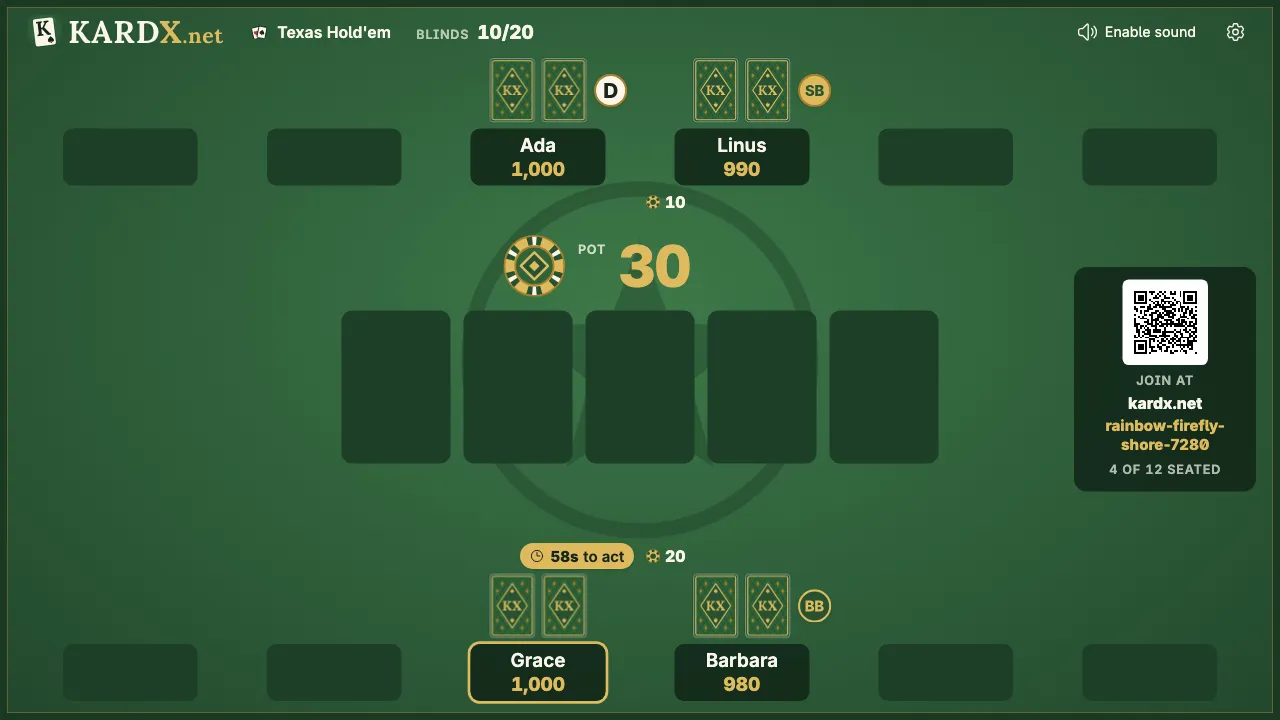
On a KARDX table the seats sit in two rows on the TV, and play goes around them in a loop: along the top row, then back along the bottom. You don't have to trace it. The seat ringed in gold is the one to act, and the D, SB and BB markers show where the count starts. Your phone shows the same markers beside the names.
Who acts when
The order is the same all hand. What changes is where it starts.
Before the flop, the two blinds have already put chips in, so the first player to decide is the seat after the big blind. Play goes around from there, and the small blind and the big blind act last.
On the flop, the turn and the river, the order starts again from the button: the first player still in after the button acts first, and the button acts last.
Take the four players in the picture. Ada has the button, Linus is the small blind, Barbara is the big blind, and Grace is the seat after her.
| Order of play | Before the flop | After the flop |
|---|---|---|
| First to act | Grace | Linus |
| Second | Ada | Barbara |
| Third | Linus | Grace |
| Last | Barbara | Ada |
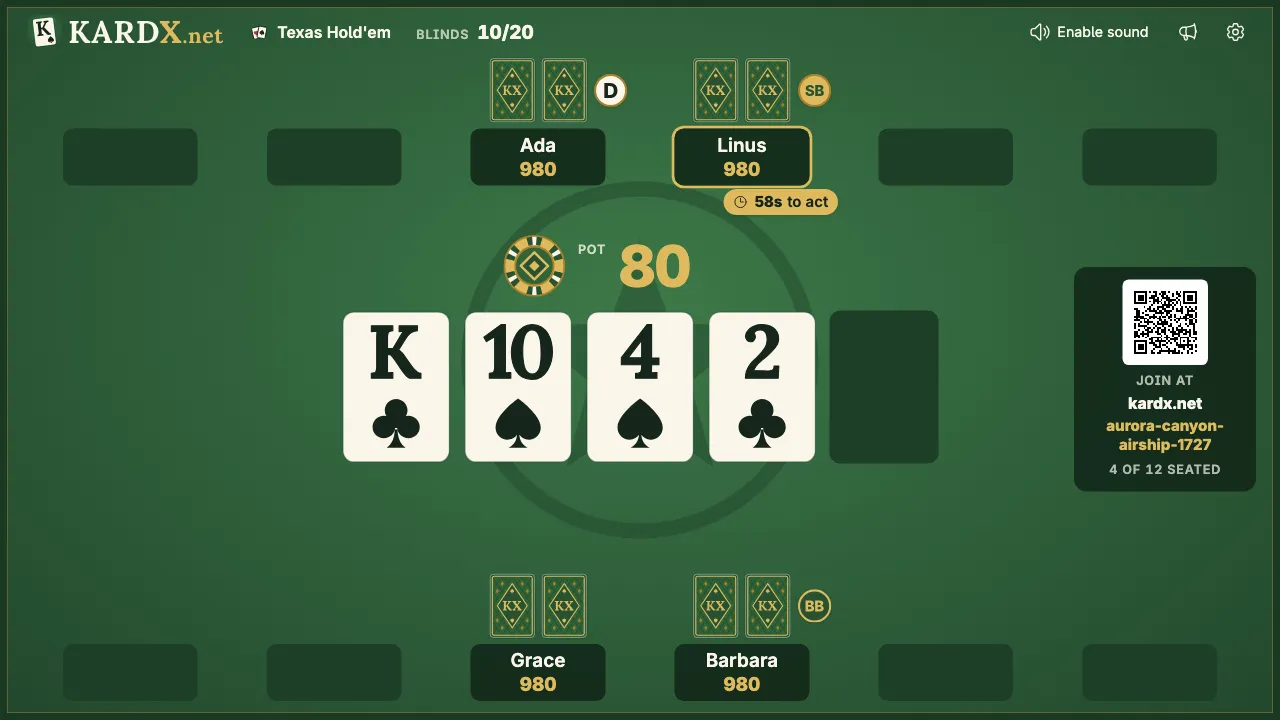
Two things stand out. The button acts last on three of the four rounds of betting. And the blinds act last once, before the flop, then first for the rest of the hand.
With only two players, the button acts first before the flop and last after it. With three, the button is the first to act before the flop.
Names for the positions
Players group the seats by how soon they have to act.
Early. The first seats to act before the flop, straight after the big blind. The very first is called "under the gun". Nearly everyone is still to act behind you, so only your strongest hands are worth playing.
Middle. The seats in between. Some players have folded, and some are still to come.
Late. The button, and the seat before it, called the "cutoff". Most of the table has acted. These are the best seats.
The blinds. The small blind and the big blind. They're last to act before the flop and first to act after it, so over a whole hand they're the worst seats.
How many seats count as early depends on how many are playing. With four players, only one seat sits between the big blind and the button, so it's first to act and next to the button at once. At a full table there are many more: think of the first three or four as early, the next few as middle, and the last one as the cutoff.
Players also say you're in position when you act after your opponent, and out of position when you act before them.
Why acting last is worth so much
- You've seen everyone else first. A check, a bet or a raise from each player ahead of you is something you know and they didn't.
- You can take a free card. If everyone checks to you, you can check as well and see the next card for nothing, or bet and maybe win the pot right there. The choice is yours alone.
- You see the price before you pay it. From an early seat you call without knowing whether someone behind you will raise. On the button, nearly everyone has already had their say.
- Your mistakes cost less. Out of position, you often pay to find out you're behind. In position, you find out first.
The same hand in two seats
Say you're dealt this at a table of eight:
It's a group 3 hand in the starting hands guide: worth playing late and cheaply, and not otherwise.
First to act. Seven players are still to come, and any of them might raise. If you call and someone does, you've wasted the call or you're paying more with a modest hand. And if you do see a flop, the players behind you will act after you on every round. Fold.
On the button. Four players have folded and one has called. You've seen all of that before putting in a chip. Only the two blinds are still to act, and after the flop you'll go last. Call, or raise.
Now the flop comes:
You have four spades, so one more makes a flush. Players count 9 cards that would do it, and poker odds for beginners shows what that's worth.
On the button, if the others check to you, you choose: check and see the next card for free, or bet and give them a chance to fold. Either way, you saw what they did first.
In an early seat with the same cards, you act before them. Check, and someone may bet and make you pay to see the next card. Bet, and someone may raise. You're guessing where the button gets to choose.
What to do about it
- Early, play only strong hands. That's group 1 of the starting hands guide, and group 2 when there are six players or fewer.
- In between, play groups 1 and 2.
- Late, play more. On the button or the seat before it, add group 3 when nobody has raised.
- On the button, raise instead of calling when everyone has folded to you. If your hand is one you'd play, raise with it. Only the two blinds are still to act, and you'll act after both of them for the rest of the hand.
- In the blinds, don't chase. Calling is cheaper, because part of the bet is already in. But you'll act first on the flop, the turn and the river, and a weak hand out of position is an expensive combination.
- Watch the players who act before you. A check often means a hand they aren't proud of. It's not a promise, but it's more than they got to know about you.
- The bigger the table, the more it matters. With three players, everyone is close to the button. With 12, the first seat has 11 players still to act behind it.
None of this is a rule of the game. It's a way to make the same cards worth a little more, hand after hand.
Position on KARDX
- The markers. D is the button, and SB and BB are the blinds. They're beside the seats on the TV and beside the names on your phone. With two players, one marker shows the button and the small blind together.
- The gold ring on the TV marks the seat that acts next, with its clock.
- The button moves by itself, one seat on after every hand. A player who is out of chips or sitting out is skipped.
- The bots use position too. Before the flop the Great and Pro bots open more hands the fewer players are left to act after them, and after it they're a little quicker to bet and raise from the button and the seat before it. The Good bot plays a few more hands from those two seats. The hint in the odds row uses the Great bot's reasoning, so it leans the same way.
Try it
Open a Texas Hold'em table and practice against bots for 20 hands with one habit: before you look at your cards, find the D and say whether you're early, late or in the blinds. Then play your group 3 hands only from the late seats.
Texas Hold'em on KARDX
Open a table on the TV and everyone joins from their phone. Free, no accounts, and the chips are play money.
Keep reading
- Rules Texas Hold'em rules Texas Hold'em rules at a glance: how a hand goes from the blinds to the showdown, and the ten poker hands in order, best first, with pictures.
- Tutorial Host a poker night Run a Texas Hold'em night with no chips to count and no cards to shuffle. The TV is the table and each player's phone holds their cards. Free, no accounts.
- Tutorial Hold'em for beginners Learn Texas Hold'em in ten minutes: the blinds, the four betting rounds, what you can do on your turn and who wins at the showdown, with a hand played out.