Guide · Texas Hold'em
Poker odds for beginners: outs, the rule of 4 and 2
Count your outs, turn them into a chance with the rule of 4 and 2, and compare it with the price of a call. With the true numbers beside the shortcut.
- 9 min read
KARDX is a free card table for your TV: everyone plays on their own phone.
Turn on Show odds at a KARDX table and sooner or later the row under your cards says something like "flush draw, 9 outs". That phrase is the start of all the poker math a beginner needs. This page explains it: what an out is, how to turn outs into a chance of winning, and what to compare that chance with before you call.
This is the standard beginner's method, not something measured against KARDX's bots, and the numbers are plain arithmetic. You can do all of it in your head in a few seconds, and you'll need to: the odds row only works when there's a bot at the table. Against your friends, the arithmetic is up to you.
What an out is
An out is a card still to come that would turn your hand into the likely winner.
Right now you have ace high. But you hold two spades and there are two on the board, so one more spade gives you a flush. There are 13 spades in the deck and you can see four of them. The other 9 are your outs.
A hand like this, not made yet but one card away, is called a draw.
The draws worth knowing
| You have | You need | Outs |
|---|---|---|
| Four cards of one suit (a flush draw) | One more of that suit | 9 |
| Four in a row, like 8 7 6 5 (an open-ended straight draw) | A card at either end | 8 |
| Four to a straight with a gap, like 9 8 6 5 (a gutshot) | The one missing rank | 4 |
| Two gaps that each fill a straight, like 9 7 6 5 3 (a double gutshot) | Either missing rank | 8 |
| A flush draw and an open-ended straight draw at once | Either | 15 |
| A flush draw and a gutshot at once | Either | 12 |
| Two cards higher than the board (overcards), like ace, king | To pair either one | 6 |
| A pair made with one of your two cards | Two pair or three of a kind | 5 |
| A pair in your hand | A third card of that rank | 2 |
Count each card once. With a flush draw and an open-ended straight draw you have nine cards for the flush and eight for the straight, but two of those eight are in the flush suit and already counted. That makes 15, not 17.
One more thing to watch: four in a row with an ace at one end, like A K Q J, is open at one end only. That's four outs, the same as a gutshot.
The rule of 4 and 2
Now turn the outs into a chance:
- With one card to come, multiply your outs by 2.
- With two cards to come, multiply your outs by 4.
The answer is a percentage. With one card to come, 9 outs is about 18%. On the flop, with the turn and the river both to come, 9 outs is about 36%.
It works because there are 47 cards you can't see on the flop and 46 on the turn, so each out is worth a little over 2% a card.
Here's the shortcut beside the true numbers. With one card to come:
| Outs | The rule says | The true chance |
|---|---|---|
| 2 | 4% | 4% |
| 4 | 8% | 9% |
| 5 | 10% | 11% |
| 6 | 12% | 13% |
| 8 | 16% | 17% |
| 9 | 18% | 20% |
| 12 | 24% | 26% |
| 15 | 30% | 33% |
This table assumes 46 unseen cards (on the turn, drawing to the river). Drawing to the turn alone from the flop, with 47 unseen, is a touch lower.
With two cards to come:
| Outs | The rule says | The true chance |
|---|---|---|
| 2 | 8% | 8% |
| 4 | 16% | 16% |
| 5 | 20% | 20% |
| 6 | 24% | 24% |
| 8 | 32% | 31% |
| 9 | 36% | 35% |
| 12 | 48% | 45% |
| 15 | 60% | 54% |
With one card to come, the rule runs a little low: by nothing at 2 outs, by three points at 15. With two cards it's close up to 8 outs and runs high after that: at 15 outs it says 60% and the truth is 54%. A common fix for more than 8 outs with two cards to come is to take off the number of outs above 8: for 15 outs that's 60 minus 7, or 53%.
The catch with "times 4"
Times 4 is your chance of getting there by the river if you get to see both cards. Often one call doesn't buy that. Call a bet on the flop, miss on the turn, and you'll likely face another bet.
So:
- Use times 2 for the usual question: is this call worth it to see the next card?
- Use times 4 only when one call shows you both cards, which is when you or your opponent is all-in on the flop.
The other half: the price of a call
A chance means nothing without a price to compare it with. The price is the share of the final pot that you're putting in:
what it costs to call ÷ what the pot will be with your call in it
Say there's 150 in the pot and it costs you 50 to call. With your call the pot would be 200, and 50 is a quarter of 200. You need to win more than 25% of the time for the call to pay over the long run.
Players think of a bet as a fraction of the pot, and each size has its price:
| The bet you're facing | You need to win |
|---|---|
| A quarter of the pot | 17% |
| Half the pot | 25% |
| Two thirds of the pot | 29% |
| The whole pot | 33% |
| Twice the pot | 40% |
Then the whole method is one comparison. If your chance is higher than the price, call. If it's lower, fold.
On KARDX the odds row does this math for you. "Call 40 to win 120: need 25%" is the price: with your 40 in, the pot would be 160, and 40 is a quarter of that.
Putting it together
Back to the flush draw and its nine outs.
On the turn, facing a bet of half the pot. One card to come: 9 × 2 = 18%. The price is 25%. Fold.
On the turn, facing a bet of a quarter of the pot. Your chance is the same 18%, really closer to 20%. The price is 17%. Call.
On the flop, when your opponent goes all-in for the size of the pot. If you call, you see both cards with nothing more to pay. Your chance of making the flush is 9 × 4 = 36%, really 35%, and a flush usually wins. The price is 33%. Call, narrowly.
One draw, three answers. The cards didn't change. The price did.
One refinement for when you're ready: if you make your flush, you may win more bets on the later rounds, which makes a close call a little better than the math says. Players call that implied odds. While you're learning, treat it as a tiebreaker and nothing more.
Not every out is a good one
Count an out only if making it would probably win you the hand.
- A card that helps someone else more. If your flush card also pairs the board, someone may have made a full house. If you're drawing to the low end of a straight, the same card may give another player a higher one.
- Overcards. Pairing either of two overcards is six outs on paper, but someone may already have two pair, or the same pair with a better second card.
- Small flushes. A flush with low cards loses to a flush with high ones. A draw to the ace-high flush is worth its 9 outs. A draw to a seven-high flush is worth less.
When you're unsure, take an out or two off the count. Being a little pessimistic about a draw costs less than being a little hopeful.
Reading the odds row
With a bot at the table, Show odds on your phone puts all of this in one row under your cards. Knowing how it's worked out tells you how far to trust it.
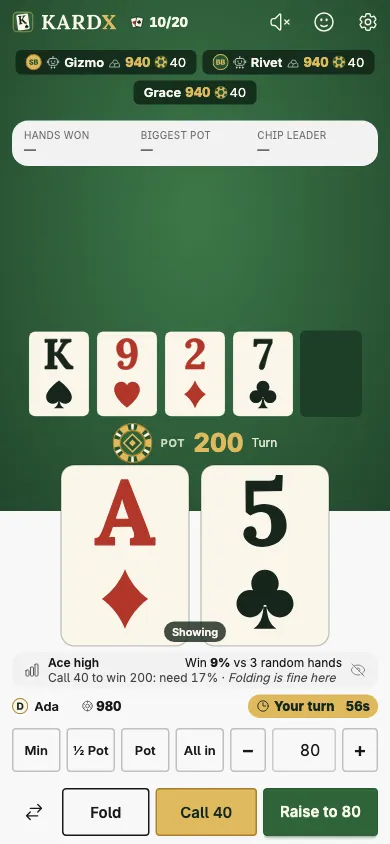
- The draws it names. On the flop and the turn it names four kinds: a flush draw (9 outs), an open-ended straight draw (8), a double gutshot (8) and a gutshot (4), and only draws one of your cards is part of: four hearts on the board are everyone's, not your flush draw. A flush draw with an open-ended straight draw shows as one total, 15 outs.
- The outs it doesn't name. It doesn't count cards that would pair you or turn a pair into something more. In the picture the hand is ace high. No draw is named, but any of the three aces left would give it a pair of aces. Those three are yours to count.
- Win. This is the full version of what the rule of 4 and 2 estimates. The table deals out the rest of the hand a few hundred times and counts how often you win. That includes the times you're already ahead, and a tie counts as a share. On the flop it assumes you'll see both cards to come, like times 4.
- "vs 3". It's your chance against that many players, each holding any two cards at random (the row says "vs 3 random hands"). A player who has been betting usually holds better than random cards, so when you're facing bets, read the number as a hopeful one.
- Before the flop it shows a rank instead. "Top 11% of hands" says where your two cards stand among all starting hands. A chance to win against everyone still in, all of them going to the end, would undersell a raise: before the flop most players fold to one. So the hint there follows a starting-hand chart for your seat ("Raise: a standard open here"), the way the Great bot plays.
- It's an estimate. The same spot can come out a few points different from one look to the next. When that's enough to change the answer, the hint says it's close ("Close: call or fold").
- The price. "Call 40 to win 200: need 17%" isn't an estimate. It's worked out exactly, the way this page does it. Before the flop the row leaves out the "need", as there's no chance to win beside it to weigh it against.
Try it
Practice against bots with the odds hidden. Each time you have a draw:
- Count your outs.
- Multiply by 2, or by 4 if someone is all-in on the flop.
- Work out the price of the call.
- Decide. Then tap Show odds and compare.
Keep going until the row stops surprising you.
Texas Hold'em on KARDX
Open a table on the TV and everyone joins from their phone. Free, no accounts, and the chips are play money.
Keep reading
- Rules Texas Hold'em rules Texas Hold'em rules at a glance: how a hand goes from the blinds to the showdown, and the ten poker hands in order, best first, with pictures.
- Tutorial Host a poker night Run a Texas Hold'em night with no chips to count and no cards to shuffle. The TV is the table and each player's phone holds their cards. Free, no accounts.
- Tutorial Hold'em for beginners Learn Texas Hold'em in ten minutes: the blinds, the four betting rounds, what you can do on your turn and who wins at the showdown, with a hand played out.