Guide · Texas Hold'em
Poker blinds explained: a home game blind structure
What the small and big blinds are, who posts them and why they rise, plus a home poker blind structure that keeps the night from running all night.
- 7 min read
KARDX is a free card table for your TV: everyone plays on their own phone.
Blinds are bets two players have to make before the cards are dealt. They're the reason there's something in the pot on every hand, and the reason you can't just fold until you're dealt aces. Once you see what they're for, the rest of the betting makes more sense.
This page explains the blinds, then how to set them for a night at home so the game ends when you want it to.
What the blinds are
There are two: the small blind and the big blind. The big blind is usually twice the small (casinos also run games like 1/3 and 2/5), and on KARDX it always is. They're written together, small first: blinds of 10/20 mean a small blind of 10 and a big blind of 20.
They're called blinds because you post them blind, before you've seen your cards.
Who posts them
One player is the dealer for the hand, and their seat has the dealer button (D). The next seat posts the small blind and the seat after that posts the big blind. After every hand the button moves on a seat, and the blinds move with it. Over a full trip around the table, everyone pays both blinds once.
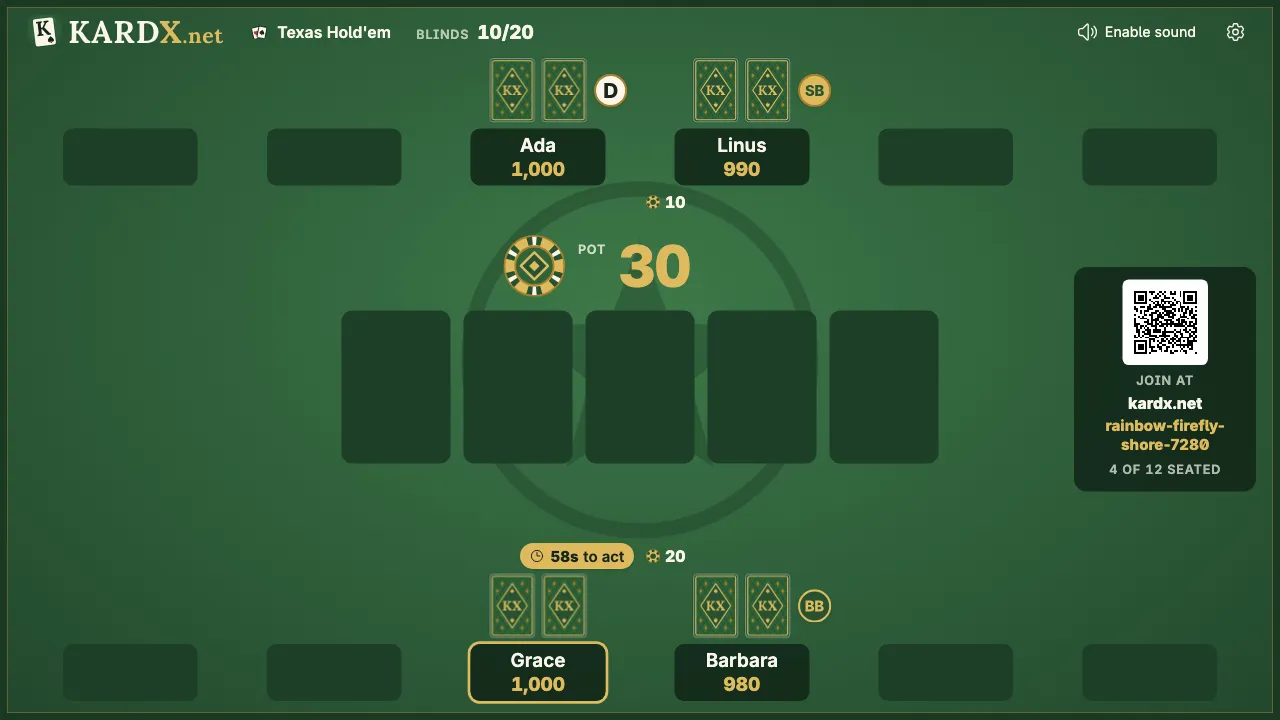
With only two players, the dealer posts the small blind and the other player posts the big blind.
On a KARDX table none of this needs remembering. The table moves the button, takes the blinds from the correct seats and marks them SB and BB.
What they do to the betting
The blinds aren't just a fee. They set up the first round of betting.
- The big blind is the bet to match. Before the flop, staying in costs at least the big blind. The first player to act is the seat after the big blind, and they can fold, call the big blind or raise.
- The blinds count. The small blind has already put in half a bet, so calling costs them only the other half. The big blind has already matched the bet.
- The big blind acts last before the flop. If nobody raised, they can check and see the flop for nothing more, or raise.
- The big blind is the smallest bet all hand. On the later rounds, a bet has to be at least the big blind. Poker betting rules has the rest: the smallest raise, all-ins and side pots.
After the flop the order changes: the first player still in after the button acts first, so the blinds go early and the button goes last. That's why the blinds are the worst seats at the table, and the button's the best. Position in poker is about exactly that.
Count your chips in big blinds
A stack of 1,000 means nothing by itself. What matters is how many big blinds it is.
At blinds of 10/20, a stack of 1,000 is 50 big blinds. At 50/100 the same stack is 10. The chips haven't changed, but the game has: with 50 big blinds you can wait for good hands and fold a lot, and with 10 every trip around the table takes a real bite and you can't wait long.
A rough guide, and it is only that:
| Your stack | How it plays |
|---|---|
| 50 big blinds or more | Roomy. You can see flops, fold when you miss and wait for a good spot. |
| Around 20 | Tighter. A raise and a bet or two is most of your stack, so pick your hands. |
| 10 or fewer | Short. Waiting costs too much. Players in this spot often put everything in with any good hand. |
Starting everyone with about 50 big blinds is a common choice for a relaxed home game, and it's what a new KARDX table starts everyone with.
Why blinds rise
If the blinds never change, a friendly game can go on all night. Careful players fold, chips drift back and forth, and nobody goes out.
Raising the blinds on a timer fixes that. Each step is called a level. As the levels climb, everyone's stack is worth fewer big blinds, waiting gets expensive, and players have to commit. Stacks collide, players go out, and the game finds a winner.
It also changes what you're playing. With fixed blinds, you play until people have had enough. With rising blinds, you play until one person has all the chips.
A schedule for a home game
Here's the ladder a KARDX table climbs when it starts from the usual 10/20. The last column is what a starting stack of 1,000 is worth at each level if it hasn't grown.
| Level | Blinds | Big blinds in a stack of 1,000 |
|---|---|---|
| 1 | 10/20 | 50 |
| 2 | 15/30 | 33.3 |
| 3 | 25/50 | 20 |
| 4 | 40/80 | 12.5 |
| 5 | 50/100 | 10 |
| 6 | 75/150 | 6.7 |
| 7 | 100/200 | 5 |
| 8 | 150/300 | 3.3 |
| 9 | 200/400 | 2.5 |
| 10 | 300/600 | 1.7 |
Each step is roughly one and a half times the last. A table that starts at other blinds climbs the same kind of ladder from wherever it starts.
How long should a level be?
The choices on KARDX are 10, 15, 20 or 30 minutes.
- 10 minutes is fast. Good for a quick game, or when half the table has to leave early.
- 15 minutes is the middle. A reasonable first pick.
- 20 or 30 minutes gives more play at each level. Better for a long evening or a big table.
How long will the night be?
Nobody can tell you exactly; it depends on how your friends play. But there's a rule of thumb people who run home tournaments use: the game tends to finish around the time the big blind reaches somewhere between a twentieth and a tenth of all the chips in play.
Take six players with 1,000 each. That's 6,000 chips, so expect the end when the big blind is between 300 and 600: levels 8 to 10 in the table above. Getting there takes seven to nine levels, which at 15 minutes a level is about two hours of hands.
More players means more chips and a longer game. Longer levels stretch it; shorter ones squeeze it. Treat the answer as a guess to plan around, not a promise.
One thing to know about the clock on KARDX: it only runs while a hand is being played. It pauses between hands, so chatting and snack breaks don't eat into a level, and the evening will run longer than the levels add up to. A level that comes due in the middle of a hand starts with the next hand.
Setting the blinds on KARDX
The blinds, the starting chips and rising blinds are set before the table's first hand. A seated player opens the settings on their phone (the ⚙ at the top) and picks:
- Blinds: 5/10, 10/20, 25/50 or 50/100, or Custom… to type a small blind of your own. The big blind is always twice the small.
- Starting chips, the stack everyone starts with: 500, 1,000, 2,000 or 5,000, or Custom… for anything from 100 to 100,000.
- Blinds rise: Never, or every 10, 15, 20 or 30 minutes.
The starting chips have to cover at least 10 big blinds, so nobody starts the night already short. If you ask for less, the settings say so.
Once the first hand is dealt, the blinds and the starting chips are fixed. To change them, start a New game from the settings: everyone goes back to the starting chips and the table is back to before its first hand.
With rising blinds on, the TV's top bar shows the blinds, the level and the time until the next one, and every screen shows a notice when they go up.
Three setups to start from
| The night | Blinds | Starting chips | Blinds rise |
|---|---|---|---|
| A relaxed game with no end time | 10/20 | 1,000 | Never |
| A game with a winner in an evening (two to three hours with the breaks), for five or six players | 10/20 | 1,000 | Every 15 minutes |
| A quick one before dinner | 10/20 | 500 | Every 10 minutes |
These are starting points drawn from the rule of thumb above, not tested recipes. Change one thing at a time and see what your table likes.
Words you'll hear
Posting. Putting your blind in.
The button. The dealer marker, and the seat that has it.
Stealing the blinds. Raising before the flop in the hope that everyone folds and you win the blinds without a fight. It gets more common as the blinds get big.
Defending. Calling or raising from a blind because someone tried to steal it.
Blinds up. The blinds have risen to the next level.
Try it
Try a schedule before your friends arrive. At a table with bots, set Blinds rise to every 10 minutes before the first hand, and each time the blinds go up, count your stack in big blinds and say which row of the "Count your chips in big blinds" table you're in.
Texas Hold'em on KARDX
Open a table on the TV and everyone joins from their phone. Free, no accounts, and the chips are play money.
Keep reading
- Rules Texas Hold'em rules Texas Hold'em rules at a glance: how a hand goes from the blinds to the showdown, and the ten poker hands in order, best first, with pictures.
- Tutorial Host a poker night Run a Texas Hold'em night with no chips to count and no cards to shuffle. The TV is the table and each player's phone holds their cards. Free, no accounts.
- Tutorial Hold'em for beginners Learn Texas Hold'em in ten minutes: the blinds, the four betting rounds, what you can do on your turn and who wins at the showdown, with a hand played out.