Tutorial · Big Two
Practice Big Two against bots: free, no sign-up
Play Big Two (Choh Dai Di) against bots on your phone, free, with no account. Pick how good they are and practice leading low, saving 2s and keeping pairs.
- 1 minute to set up
KARDX is a free card table for your TV: everyone plays on their own phone.
Big Two needs four players, and you won't always have three friends around. KARDX fills the empty seats with bots, so you can play a whole match on your own, whether to learn the game, warm up before game night or just pass the time. There's no account to make, nothing to install and nothing at stake: the scores are just points.
This page sets that up, then suggests what to practice.
What you need
Just your phone. A laptop works too.
If you've never played, read how to play Big Two first. It covers the card order and what beats what, which the rest of this page assumes you know.
1. Open a table
Go to Big Two and press Create table.
- On a phone, you go straight to the table's join page. Skip the box about putting the table on a TV or laptop: you don't need one to play alone.
- On a laptop, the screen becomes the table. Press Join from here on its bar to open the join page on the same screen.
2. Take a seat
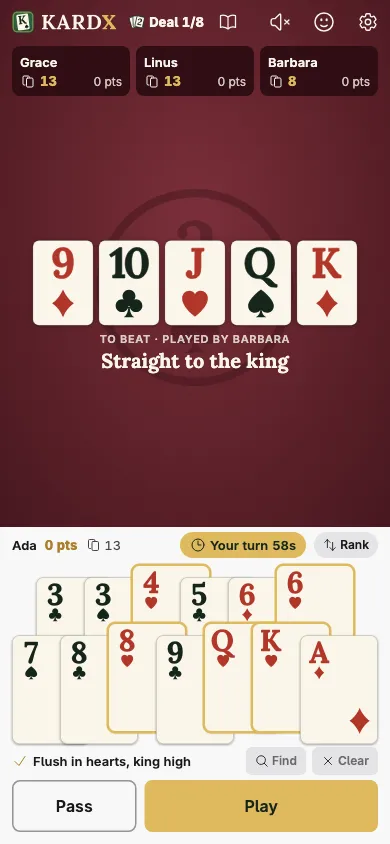
Type a name, or tap the sparkles button for one, and press Sit down. Your phone now shows your seat: the others' tags along the top, the table in the middle and your hand at the bottom. Until the first deal, the middle says Waiting for the first deal and how many people are seated.
3. Start with bots
Press Start with 3 bots. It fills the empty chairs with a Great, a Pro and a Good bot, in that order, and deals.
To choose your opponents yourself, open the settings (the ⚙ at the top) before you start, or between deals:
- Add bot seats one bot at the level picked beside it: Good, Great or Pro.
- Manage players lists everyone at the table with a Remove button, to take a bot out.
Bots sit down between deals, not during one.
4. Know who you're playing
A bot's tag has a robot head before its name, with a gauge on the head's left: one block filled for Good, two for Great, three for Pro.
| Level | What it's set to do |
|---|---|
| Good | Plays a plain game. Leading, it gets rid of its lowest card, in the biggest play that holds it. Following, it plays the weakest play that beats the table, and keeps a single 2 back while it holds plenty of cards. |
| Great | Plans its hand into plays, keeping its pairs and five-card hands whole and its 2s back. It remembers what's been played, so it knows when a play of its own can't be beaten. It sheds cards when someone else could go out first, and plays hard when someone is nearly out. |
| Pro | Plays like Great, but first plays out its best few moves over many guesses at the cards it can't see, leaning on what the others' recent passes say about their hands, and makes the one that does best. |
The table describes what each level is built to do. How well each one plays hasn't been measured against people.
Bots see only what a player in their seat would: their own cards, the table and what's been played, never your hand. They're bound by the table's rules, just as you are.
5. Use your phone's helpers
Three things on your phone help while you learn. None of them plays for you.
- The line under your hand names what you've picked ("Flush in hearts, king high") and says whether it beats the table. Play only lights when it does.
- Find steps through the plays you can make, lowest first, one per tap. Clear puts back everything you picked.
- The sort button above your hand steps through rank, suit and plays. Sorted by plays, your hand is split into the fewest plays it makes, the same split the Great bot plans its own hand with.
What to practice
These are standard beginner habits for Big Two, not something measured against KARDX's bots. How to play Big Two explains each one.
- Lead low. When you win the lead, get rid of your lowest awkward card or play. Watch how often a 3 or a 4 you led early would have been stuck in your hand at the end.
- Save your 2s. Play a 2 only when winning the lead lets you unload something right after. Count the 2s as they come out: once all four are gone, your aces win the lead.
- Don't break a pair to beat a single. Pass instead, and wait for a lead you can answer cleanly. Break a pair only when the deal is going badly and you need to get under ten cards.
- Plan your hand before the first card. Sorted by rank, split your hand into plays yourself. Then switch to sorting by plays and compare the two splits.
- Watch the counts. The others' tags show how many cards each one holds, and LAST CARD when someone is down to one. When a bot is down to two or three cards, lead a play it can't match.
Starting over, and other housekeeping
The match is over. Press New game to start another, with everyone's points back at zero.
You want more time to think. In the settings, Time for each turn sets the clock. If it runs out on your turn, you pass, or, on your lead, a single card is played for you, usually your lowest.
You want different rules. Before the first deal, or after New game, any player can change the match length and switch house rules on or off. The Big Two rules list each one.
You're done. Close the page. The server closes the table once it's been idle for a while.
Try it
Play one deal sorted by rank, and before each turn say what you'd play. Then tap Find to step through the plays you had, and see whether you missed one. When you'd rather play people, Big Two is at its best with four of you around a TV, groaning at the same 2 as it lands. On game night, open a table on the TV.
Play Big Two
Open a table on the TV and everyone joins from their phone. Free, no accounts, nothing to buy.
Keep reading
- Rules Big Two rules Big Two (Choh Dai Di) rules as KARDX plays them: card order, what you can play, scoring, the house rules a new table plays, and the eight it can change.
- Guide How to play Big Two Big Two (Choh Dai Di) explained: the card order, what you can play, how scoring works, and habits that keep you from ending a deal with a handful of cards.
- Tutorial Play online with friends Play Big Two with friends who aren't in the same room, each on their own phone. Send one link, and bots fill any empty seat. Free, no accounts, no app.